
Dynasty Match: Brain Puzzle
Luminous Arc StudiosTrivia
4.311.00 Reviews
- Version
- 1.2.0
- Installs
- 500.00K
- Age Rating
- Everyone
Screenshots

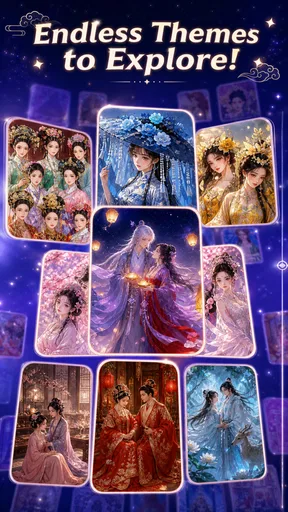
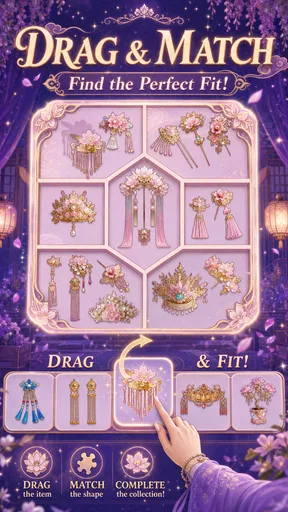




Our Review of Dynasty Match: Brain Puzzle
 Analysis by Appyee
I approached Dynasty Match: Brain Puzzle expecting a light trivia-style game with a visual twist, and that is broadly what I found: a calm puzzle experience built around arranging royal treasures by shape. Its central appeal is easy to understand within moments. You drag pieces, look for a fitting position, and gradually turn a messy collection into an orderly arrangement. The theme gives the familiar shape-puzzle idea more personality than a plain geometric board, while the relaxed presentation makes it suitable for short breaks rather than intense sessions.
That simplicity is both the game’s strength and its main limitation. I can start a round without learning a complicated ruleset, but players looking for deep strategy, a large competitive layer, or a story-driven adventure may find the design intentionally modest. The game is free to download, carries an Everyone age rating, and comes from Luminous Arc Studios. It sits in the trivia section, although the actual play feels closer to a visual brain teaser than to a question-and-answer quiz.
The current version is 1.2.0, and the game supports devices running Android 7.0 or later. Its public reception is reasonably positive, with a 4.3 average from around 2.1 thousand ratings and more than 500 thousand installs. Those figures suggest that the concept has reached a substantial audience, but they do not tell me whether it will suit every player. My experience is that the right expectations matter: this is best treated as a soothing organization puzzle, not as a demanding test of general knowledge.
How the treasure puzzles feel in everyday play
I find these treasure puzzles easiest to enjoy when I treat each board as a small visual planning task, not a race to move pieces quickly. In an ordinary spare moment, I can scan the open spaces first and save the awkward shapes for early decisions, which helps keep the session calm instead of turning it into trial and error. That simple rhythm also makes it easier to judge whether the game’s pace suits me.
A gentle start that favors observation
The most approachable part of Dynasty Match is the basic interaction. Dragging a treasure into a matching space gives the game an immediate, tactile quality. I do not need to memorize a long sequence of instructions before making progress. Instead, I can study the available shapes, compare their outlines, and decide which placement looks most sensible. That makes the opening moments comfortable for players who prefer learning by doing.
The royal-treasure setting also helps the board feel less sterile than a conventional shape-matching exercise. The objects give the arrangement task a visual identity, and the act of putting them in order feels more purposeful than moving anonymous blocks around. I especially like this approach for short sessions when I want something interactive but do not want to commit to a long level, a complicated story, or a fast reaction challenge.
There is a useful distinction between recognizing a possible fit and choosing the best fit. A piece may appear to belong in several areas at first glance, so I found it better to inspect the empty spaces before dragging anything. Looking for unusual corners and narrow gaps first can reduce later reshuffling. This is one of the small habits that makes the game more satisfying: I am not simply moving the first object that catches my eye; I am gradually forming a plan.
Why the relaxation angle works
The game’s strongest use case is the in-between moment. I can imagine playing it while waiting for an appointment, taking a short break from work, or winding down before bed. The lack of an intimidating setup makes it easy to open and try one puzzle without feeling that I have started a major gaming session. For someone who enjoys sorting, fitting, and visual tidying, that rhythm can be pleasantly absorbing.
It is also a reasonable choice for families because the age rating is Everyone. That does not automatically make every screen equally interesting to every age group, but it does indicate that the game is positioned for a broad audience rather than a mature one. Younger players may enjoy the clear shape relationships, while adults may appreciate the quiet concentration. I would still guide a child through the first few interactions, mainly so they understand that careful placement is more useful than dragging pieces randomly.
One practical tip is to use the game as a reset between demanding tasks rather than as a replacement for a longer game. Its appeal comes from the narrow focus of each puzzle: observe, move, adjust, and finish. If I play while distracted by several other things, the relaxing quality is weaker because I start making careless placements. A few uninterrupted minutes work better than trying to play while constantly switching between notifications.
Where the format may feel limited
The same calm design may disappoint players who want constant novelty. A shape-fitting puzzle can be satisfying, but it does not automatically provide the variety of a word-trivia game, a large logic collection, or a competitive match-three title. If your favorite trivia games depend on facts, timed answers, or surprising questions, the category label may create expectations that the actual gameplay does not meet.
I would also hesitate to recommend it to anyone who needs a strong sense of narrative progress. The royal theme gives the puzzles a recognizable atmosphere, but the core activity remains the arrangement itself. Players who want characters, dialogue, exploration, or a detailed dynasty story should look elsewhere. Here, the reward is the completion of a visual problem, not the discovery of a larger fictional world.
Another trade-off is that relaxation and challenge do not always rise together. A puzzle that is easy to understand can become less exciting once the player has mastered the visual patterns. That does not make the game poor; it simply means its long-term value depends on how much you enjoy repeating this particular kind of mental exercise. I see it as a good companion for casual play, not necessarily as the only puzzle game on a device.
Spending: what the free version means in practice
Dynasty Match is free, with optional in-app purchases priced from $1.99 to $4.99 per item. That is the important purchase context for anyone deciding whether to try it. I can begin without paying, while the available paid items create a separate spending choice rather than an entry fee. For a casual player, this makes experimentation straightforward: install it, test the puzzle style, and decide later whether anything offered is worth buying.
I would approach those purchases with a simple rule: do not spend until the core loop has earned your interest. The game’s main action is easy to understand very early, so there is little reason to buy immediately just to discover whether the basic concept suits you. Play enough to learn whether arranging the treasures remains enjoyable after the initial novelty. If it does not, a purchase will not change the underlying preference.
Families should be especially deliberate. Because the game is rated Everyone and free to start, it may be opened by a child who does not think of optional items as real spending. I recommend checking the device’s purchase controls before handing it over. That is not a criticism of this particular title; it is sensible practice for any free game with paid items. The listed price range gives adults a clear boundary for each item, but it does not replace household rules about when purchases are allowed.
I also avoid treating optional spending as proof that progress is unfair. The available purchase information establishes that paid items exist and shows their price range, but it does not by itself explain how they affect play. A fair review has to separate what is known from what is assumed. My practical advice is to enjoy the free starting experience first and judge any later offer by whether it adds genuine convenience or enjoyment for you, rather than buying out of pressure or impulse.
Progress without turning the session into a race
The appeal of this format is that progress can feel personal. I am trying to solve the arrangement in front of me, not necessarily beat another person’s score. That makes the game comfortable for players who dislike leaderboards or fast timers. I can focus on accuracy and visual order, which fits the advertised relaxing mood better than a high-pressure arcade structure would.
There is a downside to that approach for competitive players. Without a strong sense of rivalry, some users may run out of motivation once they have learned the basic placement habits. If your satisfaction comes from ranking, direct matches, or constantly improving a measurable performance, a dedicated competitive puzzle game will probably offer a clearer reason to return.
My best strategy is to treat each board as a small planning exercise. I first scan the full arrangement, then identify the pieces with the least flexible shapes. I place those before the broad, easy-to-fit objects, because the awkward pieces are more likely to create a problem later. I also pause after each move instead of dragging several pieces quickly. This reduces accidental placements and makes the puzzle feel more deliberate.
That workflow is useful in a real everyday scenario. Suppose I have ten minutes between errands and want a break that is more engaging than scrolling. I can open the game, spend the first minute examining the board, solve the most constrained spaces, and stop after a natural completion point. The session has a beginning and an end without requiring me to remember a complex storyline or coordinate with other players. For me, that is a more convincing benefit than simply calling the game “relaxing.”
Competitive fairness and the right comparison
Dynasty Match should not be judged by the same standard as a head-to-head trivia app. Its central challenge is visual organization, so fairness is less about reaction speed or factual knowledge and more about whether the puzzle gives the player a reasonable chance to understand the available placements. I found the concept most comfortable when I approached it as a private concentration activity rather than a contest.
Compared with ordinary trivia alternatives, it offers less emphasis on memory and more on spatial judgment. Someone who enjoys answering questions about history, science, or entertainment may not get the same kind of mental reward here. Compared with classic block-fitting games, however, the royal-treasure theme gives the experience a softer identity and may appeal to players who prefer decorative objects over abstract pieces.
It also differs from match-three games, where the excitement often comes from chain reactions, quick decisions, and changing opportunities. This game’s attraction is more controlled. I can inspect the board and think through a placement instead of reacting to a cascade. That makes it a better choice for a calm break, while the match-three alternative is usually better when I want momentum and visual spectacle.
For players concerned about competitive fairness, the absence of a need to outperform strangers is a positive. I am not entering a contest where spending, speed, or advanced equipment would obviously define the result. At the same time, I would not describe the game as a competitive platform. If your purchase decision depends on tournaments, ranked play, or transparent player-versus-player rules, this is not the category of experience I would choose.
Questions I would ask before installing
One natural question is whether the game is suitable for a quick session. Yes, that is where I think it fits best. The drag-and-fit premise is immediately accessible, and the Everyone rating makes it broadly approachable. I would not install it expecting a long campaign every evening, but I would keep it available for short periods of focused play.
Another question is whether it is really a trivia game. It is listed in trivia, yet the play I experienced is centered on shapes and object placement rather than answering factual questions. If you want a quiz app, choose one built around questions and answers. If you enjoy visual puzzles and do not mind the category label being broader than the mechanics, the distinction is less important.
People may also wonder whether they must pay to begin. They do not: the game is free, and optional items range from $1.99 to $4.99 each. I would still review every purchase prompt carefully and use device-level controls for children. The most sensible approach is to test the free experience first and only consider spending after deciding that the game has a lasting place in your routine.
A further concern is whether an older phone can run it. The stated minimum is Android 7.0, so devices on that operating system or a newer one meet the listed requirement. That does not guarantee identical performance on every handset, but it does make the compatibility threshold relatively accessible for many Android users. I would check the device version before installing, especially on an older family phone.
Finally, is it a good choice for someone who wants endless challenge? My answer is qualified. It can remain enjoyable if you genuinely like repeated shape organization and prefer a calm pace. It is less suitable if you need a changing story, a large trivia database, or a competitive ladder to maintain interest. Knowing that before downloading is more useful than assuming every puzzle game offers the same kind of replay value.
What I would keep in mind about trust
The game benefits from a clear basic proposition: it is free to start, the interaction is understandable, and the age rating is Everyone. The developer is identified as Luminous Arc Studios, and the current version is 1.2.0. Those details make it easy to place the app in context when deciding whether it belongs on a shared device or a personal one.
My caution is not about a specific hidden system; it is about keeping expectations disciplined. The purchase range tells me that optional spending is part of the experience, but it does not give me a reason to assume that spending is necessary. Likewise, a positive average rating and a large install count show that many people have tried it, but they cannot predict whether I will enjoy this particular puzzle rhythm.
I trust the game most when I use it for what it does well: quiet visual problem-solving in manageable sessions. I become less convinced when I imagine it as a full trivia replacement or a competitive main game. That distinction is important because a title can be honest about its core idea and still be the wrong fit for a particular player.
My final recommendation is therefore specific. Try Dynasty Match if you like organizing objects, prefer thinking before acting, and want a free casual game that can fill a few spare minutes. Keep spending optional, set purchase boundaries on shared devices, and judge the experience by the free puzzle loop rather than by assumptions about paid items. Skip it if you need factual quizzes, story progression, or serious competition. For the right player, the best reason to keep it installed is its focused, low-pressure shape-solving routine, not the promise of being an all-purpose trivia game.
Verdict
Strengths of Dynasty Match: Brain Puzzle
- Easy-to-learn match gameplay suitable for short sessions
- Brain-training style puzzles encourage concentration and planning
- Bright visuals and satisfying combination effects
- Gradually increasing difficulty keeps challenges engaging
- Playable offline in many situations without a constant connection
Limitations of Dynasty Match: Brain Puzzle
- Some levels may feel repetitive after extended play
- Difficulty spikes can make later puzzles frustrating
- Hints or extra moves may be limited without rewards or purchases
- Frequent ads can interrupt the flow between levels
- Small screen elements may be difficult to tap on some phones
Similar Picks in This Category
View All
Millionaire 2026 Quiz & Trivia
Quiz & Trivia Games by Submarine Apps4.5

Brain Test 2: Tricky Stories
Unico Studio4.7

Trivia Crack: Brain Quiz Games
etermax4.4

QuizzLand. Quiz & Trivia game
Quiz & Trivia Games by Mno Go Apps4.8

Brain Test: Tricky Puzzles
Unico Studio4.7

Logo Quiz
bubble quiz games4.5
Frequently Asked Questions
What is Dynasty Match: Brain Puzzle?
Dynasty Match: Brain Puzzle is a casual puzzle game that combines match-style challenges with a historical dynasty-themed setting. Players complete levels by matching tiles or objects, solving objectives, and progressing through a story-inspired environment. The game is designed for short sessions, making it suitable for players who enjoy relaxing gameplay with light strategic thinking and gradual progression.
How do you play Dynasty Match: Brain Puzzle?
Gameplay generally focuses on matching identical pieces to clear them from the board and complete each level’s objective. As you advance, stages may introduce limited moves, obstacles, special pieces, or other mechanics that require more careful planning. Success depends on recognizing combinations, creating powerful matches, and using boosters at the right moment rather than simply making random moves.
Is Dynasty Match: Brain Puzzle free to download and play?
The game can typically be downloaded without an upfront purchase, but free-to-play games may include optional in-app purchases. These purchases can provide extra lives, boosters, coins, or other progression benefits. Depending on the version and device, advertising may also appear between levels or during rewards. Check the store listing before downloading for current pricing and purchase details.
Does Dynasty Match: Brain Puzzle require an internet connection?
Some parts of Dynasty Match: Brain Puzzle may work without a constant internet connection, especially basic puzzle levels that are already available on the device. However, online access may be needed for advertisements, cloud saving, updates, special events, account synchronization, or in-app purchases. Offline availability can vary by version, so players should test the game after installation if offline play is important.
Is Dynasty Match: Brain Puzzle suitable for children and casual players?
The simple matching format and gradual difficulty make Dynasty Match: Brain Puzzle accessible to casual players, including people who prefer short, low-pressure gaming sessions. Nevertheless, parents should review the age rating, advertising, privacy information, and in-app purchase settings before allowing children to play. Difficulty, timers, and optional purchases may also affect whether the experience is appropriate for younger users.
Play our best games!


